
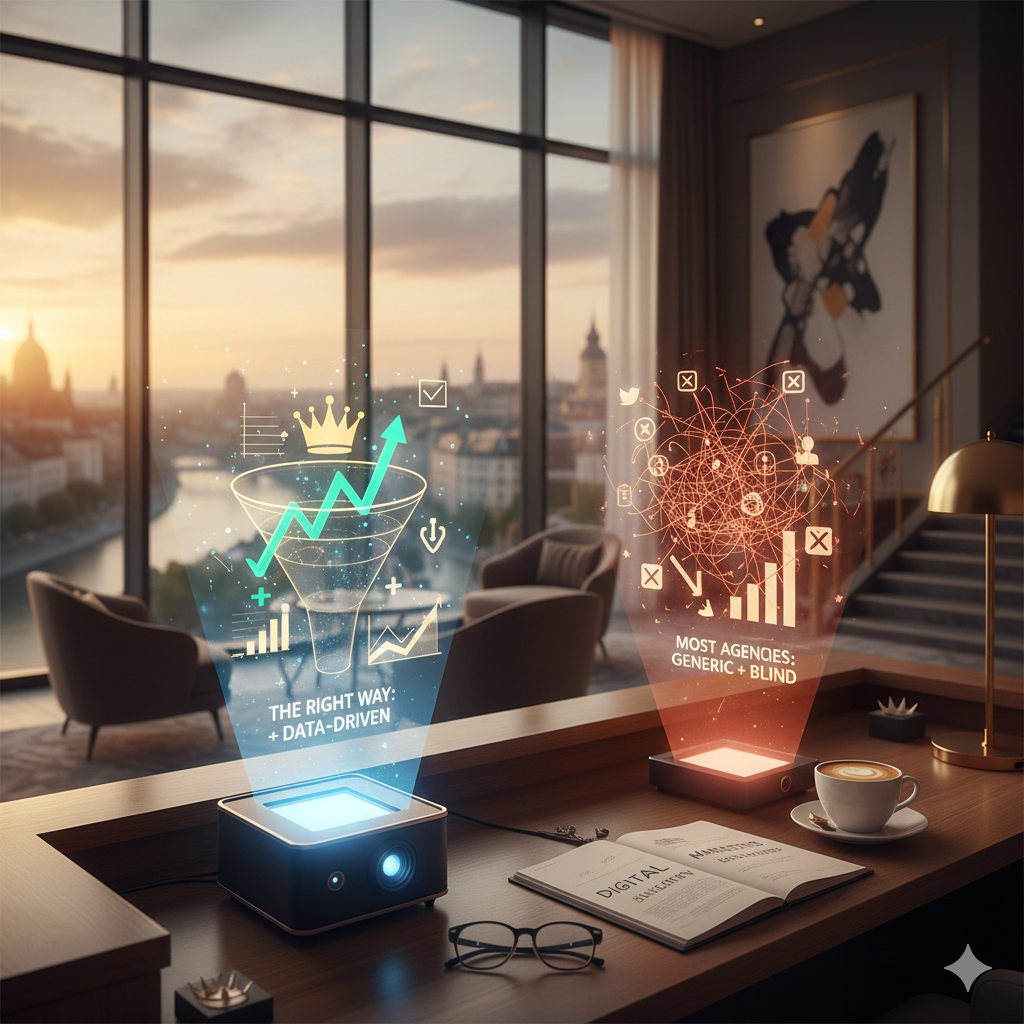
That gap is where many luxury hotel brands quietly lose margin, dilute their positioning, and weaken long-term demand - often while dashboards suggest everything is improving. What works in luxury hotel digital marketing isn’t about doing more. It’s about making better decisions, earlier.
Why luxury hotel marketing is often misjudged
Luxury marketing is frequently treated as “premium marketing with nicer creative”. In practice, that assumption causes problems.
Many agencies apply the same optimisation logic used for lifestyle or upscale hospitality, just with higher budgets and more polished visuals. That logic tends to assume that more exposure is always better, that efficiency equals success, and that increasing direct bookings should be the primary goal across every channel.
For luxury hotels, those assumptions rarely hold.
Luxury demand is shaped by perception, scarcity, and consistency. When digital activity starts to contradict those signals - even subtly - bookings may continue, but brand value starts to erode.
A different way to look at digital marketing for luxury hotels
At SideDish Media, we look at luxury hotel digital marketing slightly differently. Before performance is measured, we look at whether digital activity reinforces how the brand is meant to be perceived.
That means asking questions many marketing reports never surface. Is digital activity aligned with the offline guest experience? Is it attracting the right type of guest, not just more guests? Are channels being used for what they are good at, or being pushed to deliver outcomes they were never designed for?
These questions matter because performance metrics alone don’t show when demand quality is slipping or when exposure starts to work against perceived value.
The problem with chasing direct bookings too hard
Reducing reliance on OTAs is a sensible ambition. Making “direct bookings at all costs” the primary success metric is where many luxury hotels run into trouble.
When digital marketing becomes overly conversion-focused, creative often turns transactional, messaging shifts towards incentives, and discovery channels are pressured to close sales. Short-term gains can look encouraging, but they often come at the expense of long-term demand quality.
Luxury travel decisions are rarely made in a single session. Guests often decide long before a booking is attributed. When marketing pushes too hard, too early, it can undermine the sense of desire that luxury brands rely on.
If a booking happens faster because the brand feels cheaper, it usually isn’t a win.
Where generic hospitality marketing breaks down
The difference between generic hospitality marketing and luxury-calibrated marketing is rarely obvious at first.
Generic approaches tend to prioritise reach, efficiency, and uniform optimisation across channels. Luxury-calibrated marketing focuses more on curated exposure, clear channel roles, and consistency over constant optimisation.
The risks of getting this wrong tend to appear slowly. Over-exposure reduces perceived scarcity. Efficiency metrics start attracting the wrong guests. Channels drift into roles they were never meant to play. Performance appears strong, while brand strength weakens underneath.
By the time the impact is obvious, reversing it is far harder.
Why “best practice” doesn’t always work for luxury hotels
Best practice assumes similar audiences, similar buying cycles, and similar tolerance for repetition. Luxury hotels operate outside those norms.
What works well for high-volume hospitality often introduces over-familiarity, increases price sensitivity, and trains platforms to optimise towards outcomes that don’t support long-term brand value. This is why some luxury hotels see rising marketing efficiency alongside falling average guest value or increasing dependence on paid media.
Growth that can’t be defended in brand terms rarely lasts.
What leading luxury brands do differently
Ultra-luxury brands such as Aman or heritage properties like Claridge’s don’t succeed digitally by chasing platforms or tactics faster than others.
They succeed because they are disciplined about how demand is allowed to form. Their digital presence reinforces scarcity, maintains narrative consistency, and avoids unnecessary urgency. The lesson isn’t to copy what they do, but to understand the boundaries they refuse to cross, even when short-term performance metrics would reward them.
How AI-driven discovery changes the stakes
AI-driven search and recommendation tools don’t reward volume. They reward clarity.
When potential guests ask AI platforms to recommend hotels, those systems infer suitability based on consistent signals, clear positioning, and the absence of contradiction. Luxury hotels that dilute their messaging by over-optimising for reach, trends, or short-term performance become harder, not easier, for these systems to categorise accurately.
In this environment, brand discipline isn’t just a positioning choice. It’s a practical advantage.
The question luxury hotels should really be asking
The most important question is no longer how to improve digital marketing. It’s where digital marketing may be unintentionally undermining how the brand is perceived.
That question changes how channels are used, how KPIs are chosen, how creative decisions are made, and how agencies are evaluated. It separates marketing that performs in isolation from marketing that compounds value over time.
If there’s uncertainty about whether current digital activity is reinforcing or distorting brand value, the next step isn’t a new strategy or a bigger budget. It’s taking the time to diagnose where misalignment may already exist.
Luxury hotel digital marketing in 2026 isn’t about doing more. It’s about knowing what not to do - and being confident enough to stick to that decision.
That’s where most agencies get it wrong. And where the right approach quietly creates a lasting advantage.
