
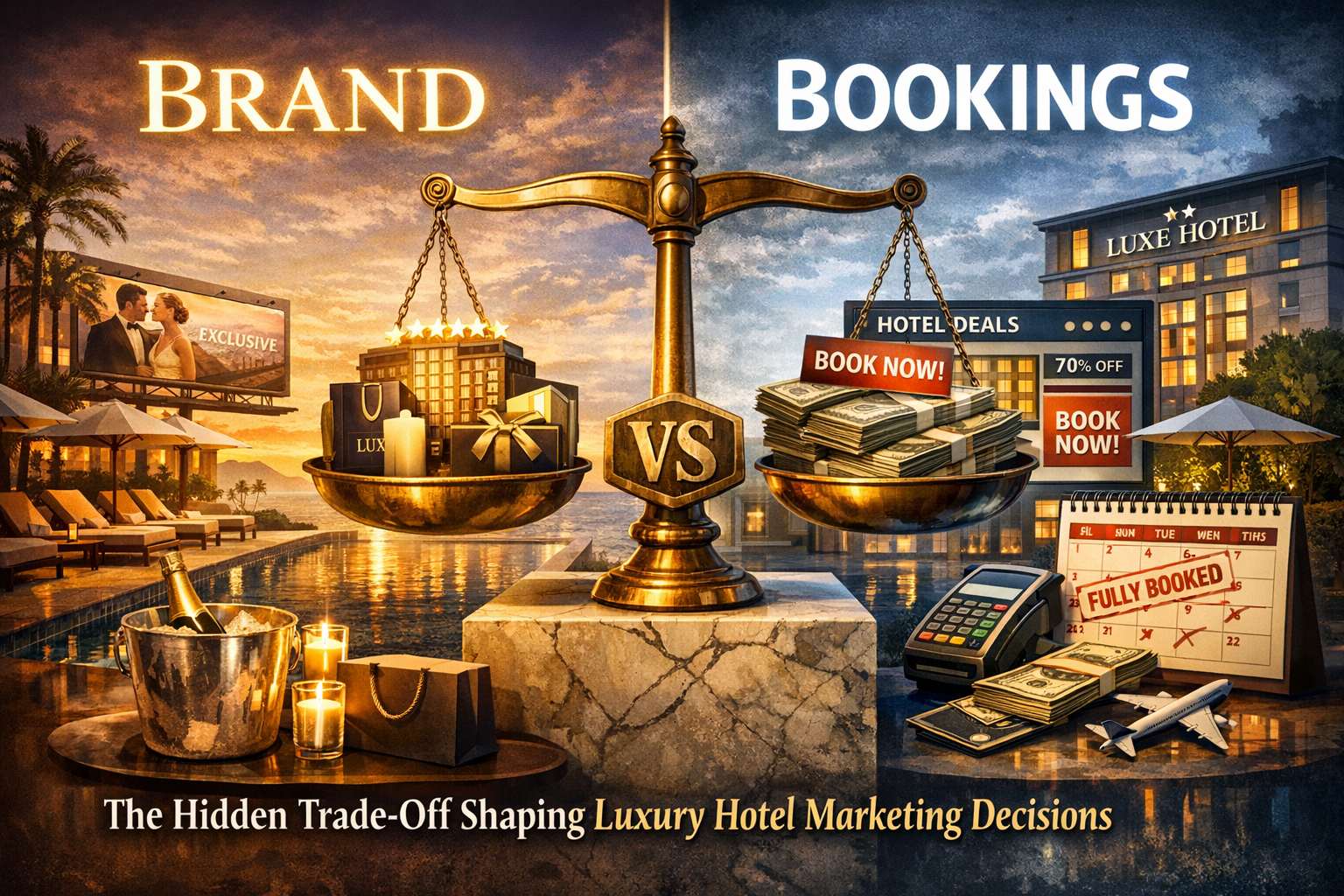
Over time, marketing decisions that were meant to be temporary become habitual. Channels are asked to do more. Messaging becomes more explicit. Performance metrics start to shape creative and targeting choices.
Bookings increase. Confidence in the brand often does not.
Why this tension keeps resurfacing in luxury hospitality
The conflict between brand and bookings isn’t a philosophical one. It’s structural.
Luxury hotels operate in an environment where marketing teams are expected to deliver visible results, often within short reporting windows. At the same time, the value of the brand is built slowly, through consistency and restraint.
That creates a mismatch. Performance activity produces immediate feedback. Brand health does not.
When decisions are repeatedly judged by what moves fastest, pressure naturally shifts toward activity that converts quickly, even if it quietly changes how the brand is perceived.
How internal pressures shape external marketing
In many luxury hotels, brand and performance decisions are influenced by different stakeholders.
Commercial teams focus on occupancy, revenue, and pace. Marketing teams are tasked with maintaining positioning. Ownership looks for confidence that investment is delivering returns. Agencies are measured on results they can demonstrate clearly.
None of these perspectives are wrong. The problem arises when short-term certainty is consistently prioritised over long-term value because it is easier to measure and defend.
Over time, this can push digital marketing into roles it was never meant to play.
When digital channels start carrying too much weight
Digital marketing is often asked to solve multiple problems at once. Drive bookings. Protect the brand. Reduce reliance on third parties. Prove return on investment.
In luxury hospitality, that expectation is rarely realistic.
Some channels are effective at creating awareness and shaping perception. Others are better suited to capturing demand that already exists. When those roles blur, messaging becomes confused and the brand loses clarity.
This usually doesn’t show up as a sudden drop in performance. It shows up as a gradual shift in tone, targeting, and guest mix.
Why booking growth can still signal underlying risk
Booking growth is reassuring. It’s visible. It’s reportable. But on its own, it doesn’t tell the full story.
Luxury hotels can increase bookings while simultaneously:
- Attracting more price-sensitive guests
- Reducing average guest value
- Increasing dependence on paid demand
- Weakening perceived exclusivity
These shifts are often subtle and only become obvious once they’ve been in place for some time.
When bookings are treated as the primary indicator of success, these signals are easy to overlook.
The role of restraint in luxury marketing
Restraint is rarely discussed in performance-driven environments, but it plays a central role in luxury brand management.
Restraint shows up in decisions like:
- Limiting exposure rather than maximising reach
- Accepting slower conversion where it protects perception
- Maintaining consistent messaging even when trends change
- Choosing not to compete aggressively on visibility
These decisions can feel uncomfortable because they don’t always align with conventional performance logic. In luxury hospitality, they are often what preserve long-term pricing power and demand quality.
What well-positioned luxury brands protect
Luxury brands that remain strong over time tend to be clear about what they will not optimise for.
They are selective about where their brand appears, how frequently it appears, and the context in which it is presented. They avoid using urgency as a default lever. They accept that not every interaction needs to be measurable to be valuable.
Brands such as Aman or long-established properties like Claridge’s are often cited not because of individual tactics, but because of the discipline they show in protecting their positioning.
The lesson is less about what they do, and more about what they consistently choose not to do.
How AI-driven discovery sharpens the trade-off
As AI-driven search and recommendation tools become more influential, the consequences of mixed signals increase.
These systems rely on consistency to understand where a hotel sits in the market. Brands that appear aspirational in one channel and transactional in another become harder to interpret accurately.
For luxury hotels, that can mean being surfaced less frequently, or being recommended for reasons that don’t align with the intended positioning.
In this context, clarity is not just a branding concern. It directly affects discoverability.
What managing the trade-off actually requires
Managing the balance between brand and bookings doesn’t mean choosing one over the other. It means being explicit about priorities and boundaries.
Luxury hotels that handle this well tend to:
- Be clear about the role each channel plays
- Accept that some activity supports future demand rather than immediate conversion
- Look beyond headline metrics when evaluating success
- Treat brand protection as a commercial decision, not a creative preference
This approach doesn’t eliminate pressure. It makes trade-offs visible and deliberate.
Why this matters more than ever
In a crowded digital landscape, luxury hotels don’t lose value by being less aggressive. They lose it by becoming indistinct.
When brand and booking objectives are allowed to drift without clear intent, marketing activity may still perform, but the brand gradually becomes harder to defend.
That’s when growth becomes more expensive, less reliable, and more dependent on constant activity.
Where this fits into the wider conversation
This tension sits underneath many of the challenges luxury hotels face in digital marketing. It influences channel strategy, creative decisions, performance expectations, and agency relationships.
For a broader view on how these dynamics affect luxury hotel marketing overall, see our perspective on what makes digital marketing work for luxury hotels – and why most agencies get it wrong.
Brand versus bookings isn’t a choice luxury hotels can avoid. But it is a tension they can manage with intent.
That’s where sustainable advantage is built.
